The Intriguing Relationship Between Eroticism and Art History
First of all, I would like to celebrate Orient Industry’s 40th anniversary. Looking back, over the past several years I have developed a surprisingly close relationship with love dolls, causing no small amount of trouble for the staff. I have also shared many evenings with President Tsuchiya at karaoke snack bars in Yushima.
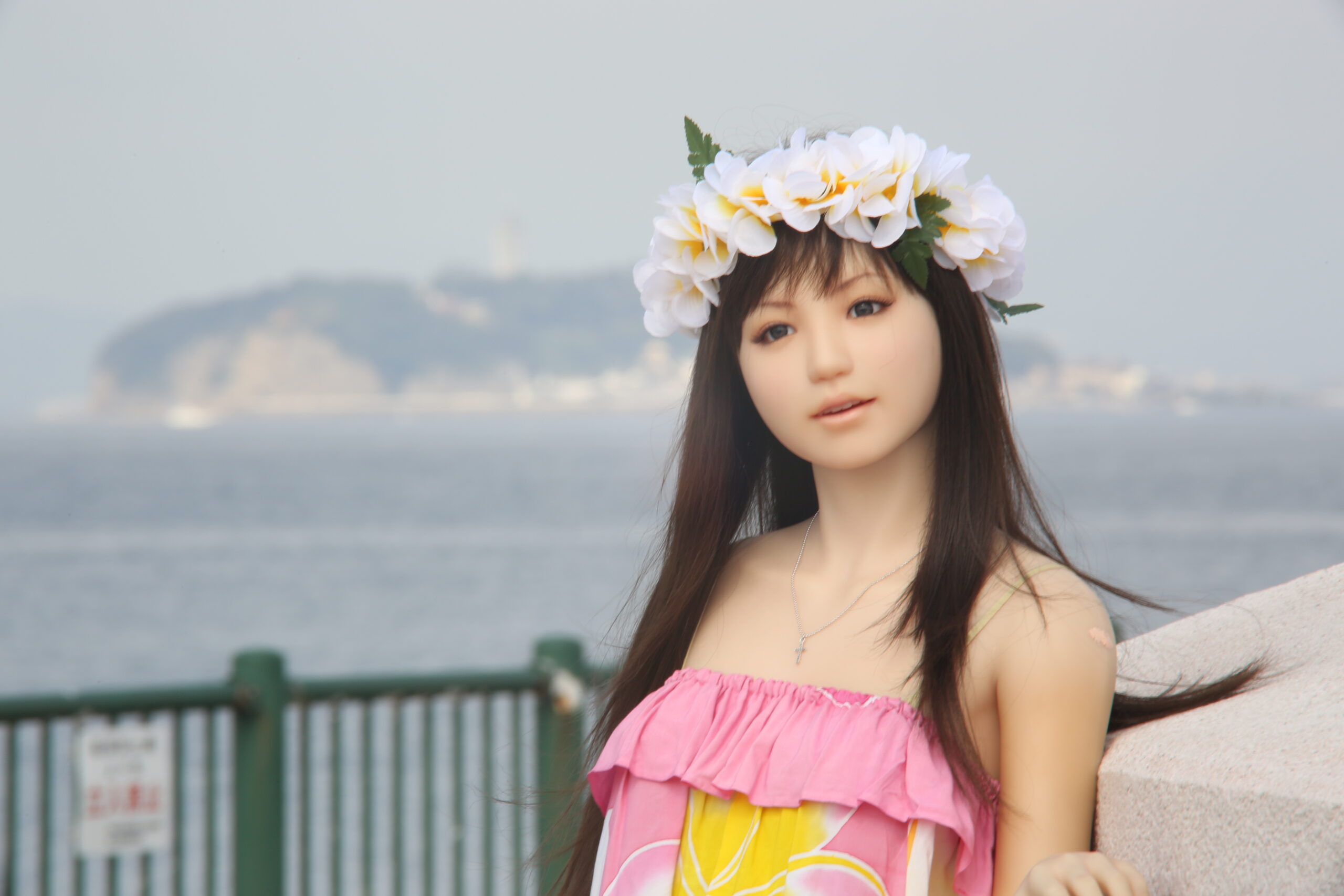
The year the company was founded, 1977, was also the year I moved from Hiroshima to Tokyo at the age of 18 to enter university. Since the release of the inflatable doll “Hohoemi” at that time, the company’s products have evolved through latex and soft vinyl materials, eventually reaching the silicone dolls of today in 2001. The performance of joints, hair implantation techniques, makeup technology, and other details have improved dramatically. And now, at the age of 58, I find myself engaging with love dolls in a rather unusual and intimate way.
I probably first learned the term “Dutch wife” during my teenage years through the urban legend of “Nankyoku No.1” (“Antarctica No.1”). However, I only began to seriously pay attention to Orient Industry’s love dolls around 2010.
Looking back now, my relationship with Ginza’s Vanilla Gallery began in 2009. The gallery had been one of the most enthusiastic supporters of bringing love dolls into society and culture. I received a thoughtful letter and invitation to the “Third Generation Hori Yoshihiro Tattoo Original Drawings Exhibition” from gallery staff member Yoko Taguchi, whom I had never met before. After that, I began attending almost every exhibition held by Vanilla Gallery.
One memorable moment was visiting the gallery shortly after the Great East Japan Earthquake on March 11, 2011, and encountering Ms. Taguchi sitting on the floor in shock after the disaster.
Vanilla Gallery’s first love doll exhibition was held in 2007 under the title “Artificial Maiden Exhibition — Orient Industry 30th Anniversary: From Dutch Wives to Love Dolls.” Unfortunately, I had not yet begun my relationship with the gallery and did not see that exhibition. However, it must have been highly successful, as follow-up exhibitions were held: “Artificial Maiden Exhibition II” in 2010 and “Orient Industry 35th Anniversary Special Exhibition: Artificial Maiden Exhibition III” in 2012. Then, for “Artificial Maiden Exhibition IV” in 2014, I contributed an essay to the exhibition catalog together with Jun Miura.
During this period, my quiet fascination and affection toward love dolls continued to grow. However, unlike Kyoichi Tsuzuki, who actively shared information about them, or Jun Miura, who placed Erika prominently in his office, I simply waited quietly, hoping that someday I might receive an opportunity related to love dolls.
Finally, in autumn 2015, Vanilla Gallery approached me with an offer:
“Would you like to produce a love doll exhibition next year?”
Naturally, I happily accepted, and the result was the 2016 exhibition “Artificial Maiden Art Museum.”
The gallery’s request was:
“Would you recreate images of Japanese art through love dolls?”
I considered many possibilities, including Edo-period ukiyo-e artists such as Utamaro, Taisho-era shin-hanga artists such as Hashiguchi Goyo, and illustrations by Komura Settai from the early Showa period. After much trial and error, I ultimately decided to base the main work on the paintings of contemporary Japanese-style painter Yasunari Ikenaga, whose popularity had been rapidly growing.
Ikenaga was born in 1965. Almost entirely self-taught, he established his own style of bijinga (paintings of beautiful women) using traditional Japanese painting materials in Azabu. After years of struggle, his recognition increased dramatically in recent years. Having long admired his work, I contributed an essay to his first art book, Kimi Omou Momo Yo no Shiawase (“The Happiness of a Hundred Nights Thinking of You”), published by Geijutsu Shimbunsha in 2014. The book continues to be reprinted today.
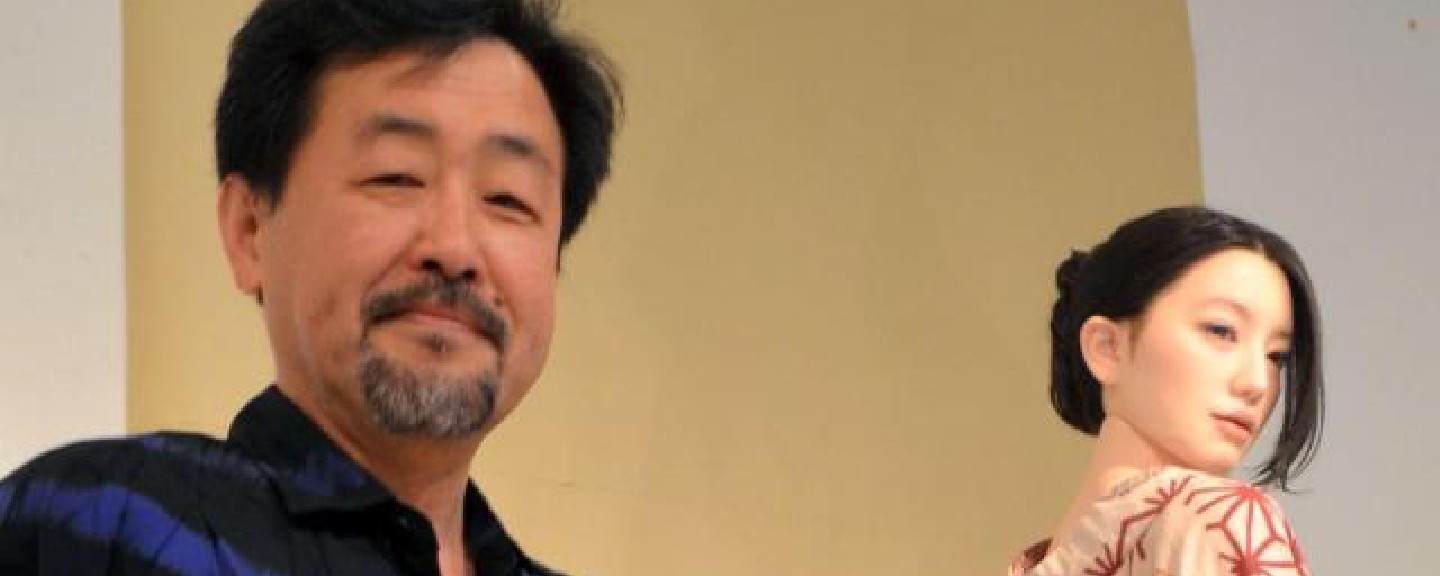
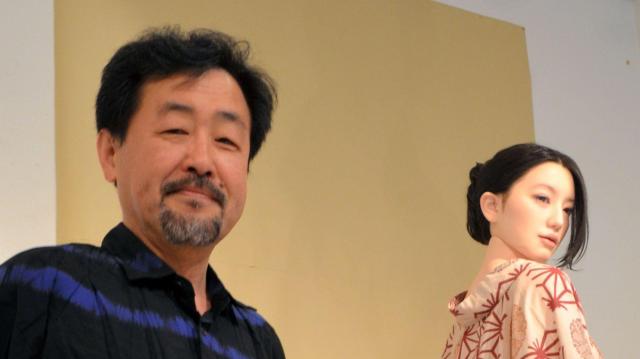
For the Vanilla Gallery exhibition, I proposed recreating Ikenaga’s work “Jōro” (“Watering Can”) as a love doll. It was a life-sized figure wearing a yukata, holding a loosened obi, and taking the famous “beauty looking back” pose. A small tin watering can was placed quietly at her feet.
First, I presented the image of this artwork to the Orient Industry staff and asked them to reproduce the atmosphere as faithfully as possible.
The process must have been extremely challenging — deciding the pose, makeup, hairstyle, and countless other details — but the staff devoted their full passion and skill to the creation. We were also able to borrow the original painting from its owner and display the artwork and the doll together in the same space.
As a result, the exhibition became a great success, attracting approximately 8,000 visitors in less than one month. That is the story behind why I am writing this essay today.
Looking back, the former “Dutch wife” was considered merely a “sexual device,” and there was almost no perspective that viewed it as art. Similarly, the life-like dolls (iki ningyo) that became popular in the early Meiji era were not considered “art” because they were viewed as entertainment objects. However, Western visitors to Japan were astonished by the incredible craftsmanship of these figures, purchased them, brought them back to their countries, and eventually placed them in museums. In recent years, Japan has finally begun to reevaluate these life-like dolls as works of art.
Finally, I would like to mention Gustave Courbet’s “The Origin of the World.” This oil painting was created in 1866 and is now housed at the Musée d’Orsay. It measures 44 × 55 cm. Images of the work can easily be found online, and I encourage you to look at it.
The painting is a close-up depiction of a woman’s lower body and genital area. Her upper body is covered with a sheet, with only a small portion of her right breast visible. Some theories suggest that the work may have been influenced by Japanese shunga (erotic prints), including those of Utagawa Kuniyoshi.
Orient Industry’s love dolls, of course, also feature carefully crafted anatomical details. Courbet likewise depicted these details with extraordinary precision.
Eroticism is one of the greatest origins of art. But when “ero” becomes “eros,” it suddenly turns into the kind of tedious intellectual discussion associated with art criticism and becomes something worthy of art history.
If I showed Courbet’s painting to President Tsuchiya, what would he say? And if I showed Courbet a love doll, what would he say?
These are the kinds of things I imagine in my mind while sharing my own private fantasies with love dolls.